
Bolt Electric Heating Rod
The bolt electric heating rod is an electric heating tool specially used for the assembly and disassembly of large bolts in steam turbines, boilers, and other pressure-containing vessels. Its core principle is to insert the heating rod into the central hole of the bolt and energize it to generate heat, causing the bolt to expand and elongate due to heating, thereby facilitating the removal or tightening of the nut—during tightening, heating causes the bolt to elongate; after tightening the nut, the heating rod is removed, and as the bolt cools and contracts, a precise preload is generated.
The bolt heating rod works based on the Joule heating effect: current passes through an internal high-resistance electric heating alloy wire to generate heat, which is conducted through a magnesium oxide powder insulating and thermally conductive layer to the wall of the stainless steel protective sleeve, and then from the sleeve wall through contact conduction to heat the inner wall of the bolt's central hole, causing the entire bolt to uniformly expand due to heating. During heating, uniform heat generation is required, and local overheating is not allowed, so as not to damage the material properties of the bolt. Basic Structure
The bolt heating rod is a multi-layer concentric structure, from inside to outside in order:
Heating core: uses 0Cr27Al7Mo2 high-resistance electric heating alloy wire, working temperature 400°C
Insulating filler layer: high-purity magnesium oxide powder (meeting HG3-1294-80 standard), must be dried before use, having both insulating and thermally conductive functions
Protective sleeve: 1Cr18Ni9Ti heat-resistant stainless steel tube, formed by cold drawing and tube shrinking, with internal burrs removed and then cleaned with gasoline or kerosene and blown dry
Cold end seal: tightly sealed to prevent moisture from entering and damaging insulation
Lead wire: the connection between the alloy resistance wire and the lead wire is firm and reliable, and must not be loose
Type Features Applicable Scenarios
Straight type (hard tube) Rigid straight rod, simple structure, easy to insert Bolts with straight-through central holes and no bends
Soft type (flexible tube) Flexible and bendable, strong adaptability Bolts with bent central holes or limited space
Semi-soft type Between straight type and soft type Slightly bent central holes
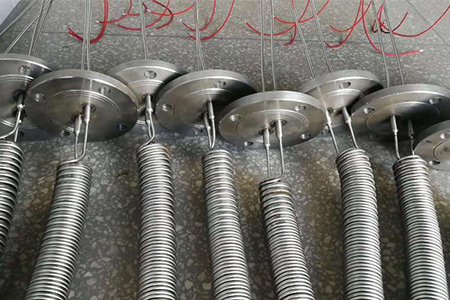
Cable type (Coiled) Flexible cable wound into a spiral shape, customizable in any outer diameter and length Occasions where there is insufficient top space and rigid heating rods cannot be inserted
By control method
Standard type: used with a DC adjustable control cabinet, manually adjusting heating power and time
Intelligent temperature control type: equipped with a PID temperature control module, can precisely set the heating curve, suitable for temperature-sensitive high-alloy steel bolts
Explosion-proof type: the casing and electrical components meet explosion-proof standards, suitable for flammable and explosive places such as petrochemical and natural gas industries
Executive standard ZBK54019-88
Rated voltage 220V±20V / DC 100V / low voltage 50V
Diameter specifications 10mm~30mm
Length range 100mm~4500mm
Surface power density 8~11W/cm²
Power deviation ±5%
Working temperature 400°C
Insulation resistance ≥50MΩ
Withstand voltage 1500V/1min without breakdown
Hot leakage current not greater than 0.5mA per kilowatt
Diameter deviation of inserted part -0.20mm / -0.50mm
Centerline straightness ≤±0.3mm within 1m, ±0.4mm within 1~2m
Bottom cold end length 25~30mm
Cumulative service life ≥50 hours (intermittent heating working condition)
Application Fields
Power industry: disassembly and assembly of large bolts in steam turbine cylinders, hot tightening of boiler flange bolts, the most core application scenario
Petrochemical: disassembly, assembly and maintenance of large bolts in reactors, heat exchangers, pipeline flanges, etc.
Coal chemical industry: bolt maintenance of high-temperature and high-pressure equipment such as synthesis towers and gasifiers
Heavy machinery: bolt tightening for large pressure vessels and forging equipment
Ship engineering: maintenance of large bolts in marine diesel engines, boilers, etc.
🛠️ Usage Method
Preparation stage: confirm that the power supply is turned off, check that the insulation resistance of the heating rod is qualified, and confirm that the fit clearance between the heating rod diameter and the bolt central hole is within the range of 0.8~1.3mm
Insert the heating rod: insert the heating rod into the bolt central hole, ensuring it is inserted in place; the heating position is the screw section, avoiding direct heating of the threaded and nut parts
Energize for heating: connect the control cabinet, set the heating time and power, and start heating. Each heating time is generally 10~20 minutes
Disassembly and assembly operation: after the bolt expands, quickly perform nut removal or tightening operation
Remove the heating rod: remove the heating rod promptly after the operation is completed; the casing must be well grounded
Safety precautions: it is strictly prohibited to insert open flames such as torches directly into the bolt hole for static heating, to prevent local overheating of the hole wall from causing cracks. During heating, the temperature of the central hole wall must not exceed the maximum service temperature of the bolt.
Comparison with Traditional Heating Methods
Comparison Item Bolt Heating Rod Hot Air Convection Heating Open Flame Heating
Heating uniformity Uniform Relatively uniform Uneven, prone to local overheating
Safety High (no open flame) High Low (fire risk)
Temperature control accuracy Can be precisely controlled Controllable Difficult to control
Applicable temperature ≤400°C 250~450°C Uncontrollable
Operational convenience Ready to use upon insertion Requires supporting gas source equipment Complex operation
Matching bolt central hole diameter: standard products are suitable for bolts with a central hole diameter of 22.6±0.2mm; other specifications need to be customized through consultation with the manufacturer
Determine insertion length: select the heating rod length according to the bolt length, noting that the bottom cold end length (25~30mm) is not counted as effective heating length
Select structural form: choose straight type for straight-through holes, soft type for bent holes or limited space, and cable type for insufficient top space
Confirm voltage level: choose 220V AC, 100V DC, or 50V low voltage according to on-site power supply conditions
Explosion-proof requirements: explosion-proof type must be selected for hazardous areas such as petrochemicals
Supporting control cabinet: the heating rod needs to be used with a DC adjustable control cabinet; the intelligent temperature control type can achieve precise heating curve control