
Bolt Electric Heating Rod
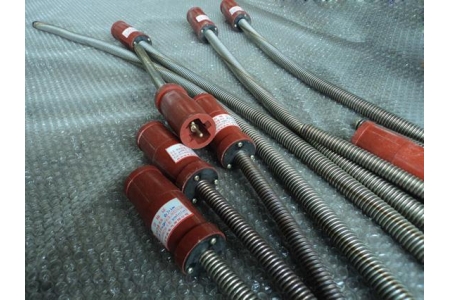
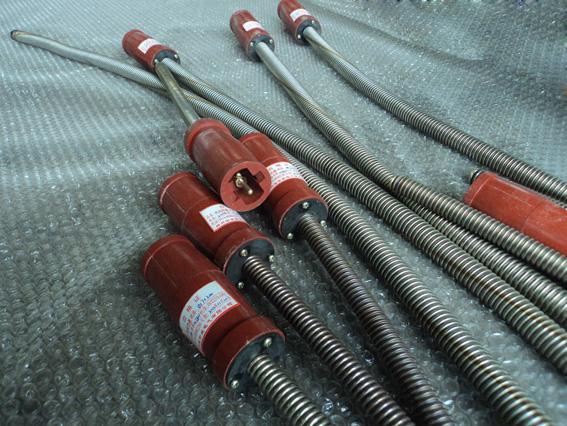
A bolt electric heating rod is an electric heating tool specially used for the disassembly and assembly of high-strength bolts in large equipment (such as steam turbines, boilers, pressure vessels, etc.). Its core principle is to insert the heating rod into the center hole of the bolt and energize it for heating, causing the bolt to expand and elongate due to heat, thereby easily tightening or removing the nut. The implementation standard is ZBK54019-88.
Working Principle
The working process of the bolt electric heating rod is divided into two stages:
Heating Expansion (Tightening): Insert the heating rod into the center hole of the hollow bolt and energize it for heating. The bolt expands and elongates along the axial direction due to heat, allowing the nut to be easily tightened into place.
Cooling Contraction (Pre-tightening): After removing the heating rod, the bolt naturally cools and contracts, generating a huge axial pre-tightening force that compresses and seals the flange surface.
For disassembly scenarios, after heating causes the bolt to expand, the friction between threads is reduced, and corroded or seized bolts can be easily unscrewed.
Structural Composition
The structure of the bolt electric heating rod from inside to outside is as follows:
Heating Element: 0Cr27Al7Mo2 high-resistance electric heating alloy wire, working temperature 400°C
Insulation Filling: High-purity magnesium oxide powder (must be dried), filled between the heating wire and the sleeve
Protective Sleeve: 1Cr18Ni9Ti heat-resistant stainless steel tube, formed by cold-drawing and tube shrinking, with no cracks allowed on the surface
Cold End: The cold end at the bottom is 25-30mm long, and the sealing at the closure is tight to prevent moisture intrusion
Lead Wire: The connection between the alloy resistance wire and the lead wire is firm and reliable, without looseness
Main Classifications
Table
Download as Table
Export as Image
Type Features Applicable Scenarios
Standard Type (Resistance Heating Rod) Inserted into the bolt center hole for direct heating, simple structure Routine bolt disassembly and assembly in steam turbines and boilers
Explosion-proof Type The shell and electrical components comply with explosion-proof standards Flammable and explosive places such as petrochemical and natural gas industries
Intelligent Temperature Control Type Equipped with PID temperature control module, can set heating curves Scenarios sensitive to temperature such as high-alloy steel bolts
Flexible Cable Type Bendable spiral cable heating element Occasions with limited space where rigid rods cannot be inserted
Induction Heating Type (New) Uses electromagnetic induction to generate eddy currents inside the bolt for heating New maintenance solutions, more uniform heating
Main Technical Parameters
Table
Download as Table
Export as Image
Item Parameter
Implementation Standard ZBK54019-88
Rated Voltage AC 220V±20V / DC 100V / Low voltage 50V
Surface Power Density 8-11W/cm²
Power Deviation ±5%
Diameter Specifications 10mm-30mm
Length Range 100mm-4500mm
Insertion Part Diameter Deviation -0.20mm / -0.50mm
Working Temperature 400°C
Insulation Resistance ≥50MΩ
Withstand Voltage 1500V/1min without breakdown
Hot-state Leakage Current ≤0.5mA/kW
Cumulative Service Life ≥50 hours (under intermittent heating conditions)
Typical Model Specifications
Taking the DJ22 series as an example (applicable to bolts with center hole diameter d=22.6±0.2mm):
Table
Download as Table
Export as Image
Model Applicable Bolt Sleeve Length (mm) Heating Length (mm) Power (W)
DJ22-1 M56×4 255 100 550
DJ22-2 M56×4 280 126 700
DJ22-3 M56×4 305 150 850
DJ22-4 M56×4 330 175 1000
DJ22-5 M56×4 355 200 1150
DJ22-6 M56×4 380 225 1300
Different bolt diameters and center hole sizes require customized heating rods of corresponding specifications. When ordering, parameters such as bolt outer diameter, total length, and nut length must be provided.
Supporting Control Cabinet
Bolt heating rods are usually used with a DC adjustable control cabinet, with the following main features:
Stable and adjustable DC output voltage (0-220V)
Multiple output channels, up to 12 loads
Large output power, safe and reliable
Strictly prohibited to switch voltage under load
The shell must be reliably grounded
Usage Precautions
Uniform Heating: The heating rod must be inserted into the center hole of the bolt to ensure uniform heating, and local overheating is strictly prohibited
Temperature Control: The temperature of the center hole wall must not exceed the maximum service temperature of the bolt material
No Open Flames: It is strictly prohibited to insert a torch directly into the hole for static heating to prevent local overheating and cracks on the hole wall
Power-off Operation: The power must be disconnected when installing or removing the heating rod
Voltage Zeroing: The voltage adjustment of the control cabinet should be set to the minimum position before shifting gears
Three-phase Balance: Pay attention to the balance among the three phases when connecting multiple loads
Moisture-proof Sealing: The cold end closure must be tightly sealed to prevent moisture from entering and damaging the insulation
Connector Maintenance: If the connector is damaged, it must be replaced with the original specification and must not be arbitrarily substituted
Application Fields
Table
Download as Table
Export as Image
Field Typical Uses
Power Industry Bolt disassembly and assembly for high/medium/low pressure cylinders of steam turbines, tightening of boiler flange bolts
Petrochemical Disassembly and assembly of pressure vessel flange bolts and pipeline flange bolts
Metallurgical Industry Tightening of pressure bolts on large equipment
Shipbuilding Disassembly and assembly of large bolts on main engines and pipelines
Relationship with Heating Products You Have Learned Before
Among the several electric heating products you have learned about, the bolt electric heating rod is positioned as a special tool-type heating tool, clearly distinguished from other products:
Table
Download as Table
Export as Image
Product Heating Object Heating Method
Bolt Electric Heating Rod Large high-strength bolts Inserted into the center hole of the bolt for internal heating
Heating Coil Barrels, pipes outer surface Ring wrapping external heating
Heating Plate Molds, panels Flat surface contact external heating
Pipeline Heater Fluid media Media flows through the equipment for internal heating
Heating Cable Pipe outer wall Wrapping external insulation
In simple terms, the bolt electric heating rod is the only product that "heats by insertion," specifically designed to solve the difficult problem of disassembling and assembling large bolts. It is an indispensable professional tool in power plant maintenance and heavy equipment installation.