
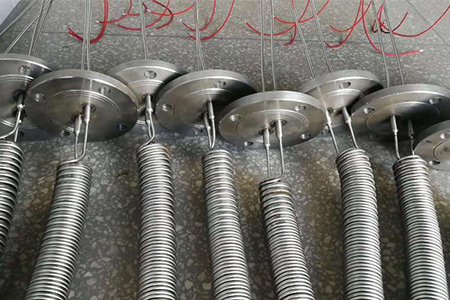
Bolt electric heating rod is an electric heating tool specifically designed for heating fastening or disassembly of large bolts. Its most typical application scenario is the disassembly and assembly of steam turbine cylinder bolts, and it is also widely used for maintenance of large bolts in high-temperature and high-pressure flange connections such as pressure vessels, power station boilers, and chemical equipment.
Working Principle
The bolt electric heating rod is essentially an insertion-type tubular electric heater. It is inserted into the pre-drilled heating hole in the center of the bolt. When powered on, the resistance heating wire generates heat, which is transferred through the magnesium oxide insulating and thermally conductive layer to the surface of the metal sheath tube, and then conducted from the tube wall to the bolt body. The bolt expands axially after heating, generating pre-tightening force for fastening; or it loosens rusted/seized bolts for easy disassembly.
After heating is completed, the bolt cools and contracts to achieve precise pre-tightening effect. The entire process does not require mechanical force tools such as hydraulic wrenches, causing minimal damage to the bolt and flange surface.
Structural Composition
The structure of the bolt electric heating rod is similar to conventional tubular electric heaters, but it is specially optimized for bolt heating scenarios:
Resistance heating wire: Made of high-resistance electric heating alloy wire such as 0Cr27Al7Mo2, with a working temperature of about 400°C
Magnesium oxide insulation layer: Filled between the heating wire and the sheath tube, must be dried before use, providing both thermal conductivity and insulation
Metal sheath tube: Made of 1Cr18Ni9Ti heat-resistant stainless steel tube, formed by cold drawing and tube shrinking, with no defects such as cracks on the surface
Cold end and lead wire: The cold end at the bottom is generally 25-30mm long, and the connection between the alloy resistance wire and the lead wire must be firm and reliable
Sealing: The cold end sealing must be tight to prevent moisture from entering and damaging insulation
Product Types
Table
Download as table
Export as image
Type Features Applicable Scenarios
Standard (straight) Rigid rod body, simple structure, suitable for shorter bolts Conventional power station boilers, steam turbine bolts
Flexible (soft) Rod body can be bent to adapt to insertion needs of longer bolts Heating of deep-hole long bolts
Explosion-proof Shell and electrical components meet explosion-proof standards to prevent electric sparks from causing accidents Flammable and explosive places such as petrochemical and natural gas industries
Intelligent temperature control Equipped with PID temperature control module, can precisely set heating curve Fastening of high-alloy steel bolts sensitive to temperature
Induction heating Uses electromagnetic induction principle, non-contact heating, more uniform heating of bolt body Rapid heating of large bolts, no exhaust emissions
Typical Technical Parameters
Taking power station steam turbine bolt heating rod as an example (executive standard ZBK54019-88):
Table
Download as table
Export as image
Parameter Indicator
Rated working voltage AC 220±20V / DC 100V / Low voltage 50V
Heater diameter 9mm / 15mm / 18mm / 22mm
Surface power density 8-11W/cm²
Insertion length From hundreds of mm to 2m, customized according to bolt specifications
Single rod power Approximately 1.5kW-10kW
Straightness requirement ≤0.3mm when ≤1m; ≤0.4mm when 1-2m
Diameter deviation of inserted part -0.20mm / -0.50mm
Cumulative service life No less than 50h under intermittent heating conditions
Matching Control Cabinet
Bolt electric heating rods are usually used with a dedicated DC control cabinet. The main features of the control cabinet include:
Rectified output: Uses thyristor three-phase full-wave rectification circuit, with smooth DC output waveform, which can reduce the peak voltage borne by the heating rod by nearly 40% compared to AC heating, greatly extending the service life of the heating rod
Adjustable voltage: DC output voltage can be continuously adjusted between 0-180V, unaffected by grid voltage fluctuations, making it easy to select appropriate heating power according to different working conditions
Multiple outputs: Generally provides 6-12 output branches, each with independent switch control, and single branch output power can reach 6kW
Operation method: First turn the voltage knob to zero, close the main circuit switch and power switch, slowly adjust the voltage knob to the desired value (generally set at 110-130V), after heating is completed, turn off the heating switch and return the voltage to zero
Application Fields
Power industry: Disassembly and assembly of steam turbine cylinder bolts (most typical application), heating of power station boiler flange bolts
Petrochemical: Fastening and disassembly of high-temperature and high-pressure pipeline flange bolts
Heavy machinery: Maintenance of large pressure vessels and reactor flange bolts
Shipbuilding: Large bolt operations on marine engines and piping systems
Usage Precautions
Matching clearance: A reasonable fit clearance (generally total clearance 0.8-1.3mm) should be maintained between the outer diameter of the heating rod and the center hole of the bolt. Excessive clearance affects heat conduction efficiency, while too small clearance makes insertion difficult
No dry heating: The heating rod must be fully inserted into the bolt hole before powering on. The exposed part must not be powered for heating
Proper grounding: The shell must have reliable grounding protection
Moisture-proof storage: Store in a dry environment. If damp, the insulation resistance decreases and drying treatment is required
Uniform heating: During heating, ensure uniform heat generation, and no local overheating is allowed
Life management: Replace promptly when cumulative use reaches the service life limit to avoid insulation failure due to tube aging