
Bolt Electric Heating Rod
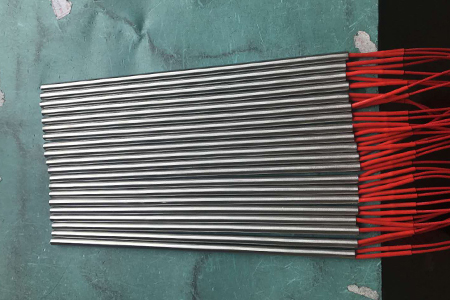
A bolt electric heating rod is a specialized electric heater dedicated to the installation, removal, and tightening of high-temperature bolts in large equipment such as steam turbines, boilers, and pressure vessels. It is inserted into the central hole of a bolt and energized to generate heat, causing the bolt to expand and elongate, thereby allowing the nut to be easily tightened or removed. After cooling, the bolt contracts to produce preload, ensuring the sealing reliability of the flange connection.
Working Principle
The core principle of the bolt heating rod is the thermal expansion tightening method:
Insertion heating: Insert the heating rod into the pre-machined central hole of the bolt
Energized heating: Electric current passes through the internal high-resistance electric heating alloy wire to generate Joule heat, and the heat is conducted through the stainless steel sleeve to the inner wall of the bolt
Bolt elongation: After being heated, the bolt expands and elongates axially, and the nut can be easily turned to the target position
Power-off cooling: Remove the heating rod, and the bolt naturally cools and contracts, generating precise axial preload
Sealing and locking: The preload ensures tight fitting of the flange surfaces, meeting the sealing requirements under high-temperature and high-pressure working conditions
The heating position should be controlled within the threaded rod section, avoiding direct heating of the threads and nut portion, to prevent thread deformation from affecting fit accuracy.
Protective sleeve 1Cr18Ni9Ti heat-resistant stainless steel tube Shell protection, conducts heat to the bolt
Heating wire 0Cr27Al7Mo2 high-resistance electric heating alloy wire Converts electrical energy into thermal energy, working temperature 400℃
Insulating filler High-purity magnesium oxide powder (dried treatment) Electrical insulation + thermal conductive medium
Cold-end lead Heat-resistant wire Connects to power supply, bottom cold-end length 25~30mm
Sealed end Cold-drawn reduced tube + sealed closure Prevents moisture intrusion from damaging insulation
After the steel sleeve is formed by cold-drawing and tube reduction, the surface must be inspected by dye penetrant testing or a magnifier of 5× or greater, and there must be no defects such as cracks.
Executive standard ZBK54019-88
Rated voltage 220V±20V / DC 100V / low voltage 50V
Surface power density 8~11W/cm²
Power deviation ±5%
Working temperature 400℃
Diameter specifications 10mm~30mm
Length range 100mm~4500mm
Diameter deviation of insertion part -0.20mm / -0.50mm
Length deviation of insertion part ±5mm
Insulation resistance ≥50MΩ
Withstand voltage 1500V/1min without breakdown
Hot leakage current Not greater than 0.5mA per kilowatt
Cumulative service life ≥50 hours (intermittent heating working condition)
Centerline straightness ≤1m length: φ0.3mm; 1~2m length: φ0.4mm
Straight tube type (hard tube) Rigid structure, good straightness Bolt center hole is straight-through and there is sufficient insertion space
Flexible tube type Bendable, strong adaptability Occasions with limited space and requiring bending insertion
Semi-flexible tube type Between the two Medium space limitation scenarios
Cable type (Coiled) Spiral wound structure, can be coiled to any diameter Occasions with no top space and requiring side insertion
Typical Specification Examples
The following are typical specification configurations in actual procurement (22mm diameter series):
Model Total length Cold end length Heating length Power (W) Structure
K09-6Z 1353mm 208mm 1115mm 8423~10018 Flexible tube
K09-3Z 650mm 160mm 460mm 3880~4270 Flexible tube
K09-4Z 1083mm 208mm 845mm 6161~6771 Flexible tube
K09-24Z 506mm 160mm 316mm 1544~1764 Straight tube
K09-25Z 710mm 160mm 520mm 2757~3308 Straight tube
K09-26Z 585mm 160mm 395mm 2260~2714 Straight tube
Operating Procedure
Heating tightening (hot tightening)
Confirm that the bolt center hole is clean and free of foreign matter, and measure the gap between the hole diameter and the outer diameter of the heating rod (recommended 0.8~1.3mm)
Insert the heating rod into the bolt center hole, ensuring it is fully in place
Connect the power control cabinet and set the heating time (usually 10~20 minutes per cycle)
Energize and heat until the bolt elongation reaches the preload requirement
Quickly tighten the nut to the target position
Power off and remove the heating rod, and the bolt naturally cools and contracts to complete preload
Heating removal (hot removal)
Insert the heating rod and energize to heat, causing the bolt to expand and loosen
While hot, loosen the nut and remove the bolt
Safety Precautions
During heating, the temperature of the center hole wall must not exceed the maximum service temperature of the bolt, and uniform heating is required to prevent local overheating
It is strictly prohibited to insert a torch directly into the hole for static heating, to prevent local overheating of the hole wall from causing cracks
The shell must be well grounded
The connection between the alloy resistance wire and the lead wire should be firm and reliable, with no looseness
Fossil fuel power generation Hot tightening/hot removal of steam turbine cylinder flange bolts, boiler manhole door bolts
Petrochemical Reactor flange bolts, heat exchanger tube sheet bolts, pipeline flange bolts
Nuclear power Pressure vessel main bolts, steam generator flange bolts
Heavy machinery Large presses, forging equipment fastening bolts
Shipbuilding Main engine cylinder head bolts, pipeline flange bolts
Comparison of New Heating Methods
Comparison item Resistance heating rod Electromagnetic induction heating
Heating method Inserted into the bolt center hole for heating Induction coil sleeved outside the bolt for heating
Applicable conditions Bolt needs a pre-machined center hole No center hole required, external induction
Heating uniformity Good (inner wall uniformly heated) Good (rod body uniformly heated when coil is centered)
Response speed Relatively slow (requires conduction heating) Fast (eddy current directly generates heat)
Portability Requires supporting control cabinet Handheld equipment has matured
Safety Requires protection against electric shock and dry burning No open flame, non-contact heating
Development trend Mature and stable, still mainstream Direction of intelligentization, enterprises such as Huaneng have applied for related patents
Selection Points
Confirm the bolt center hole diameter: the outer diameter of the heating rod must match the hole diameter, with the gap controlled at 0.8~1.3mm
Determine the insertion length: select the heating section length of the heating rod according to the effective length of the bolt
Choose the structural form: choose straight tube type when space is sufficient, and flexible tube type when space is limited
Match the voltage level: conventionally choose 220V; for special working conditions, DC 100V or low voltage 50V can be selected
Supporting control cabinet: a DC adjustable control cabinet is required, with overcurrent and overheating protection functions
Explosion-proof requirements: for petrochemical occasions, the explosion-proof grade must be confirmed (such as ExdⅡBT4)
ZBK54019-88: Industry standard for steam turbine bolt electric heaters
GB 1234: Standard for high-resistance electric heating alloys
HG 3-1294-80: Magnesium oxide standard
YB 804: Standard for stainless acid-resistant steel seamless steel tubes