
Electric heating coil
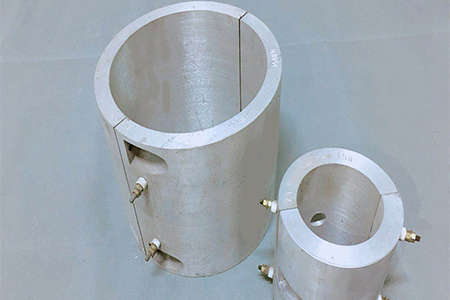
Electric heating coil, also commonly known as electric heating ring or heating coil, is a ring-shaped heating element that efficiently converts electrical energy into thermal energy. It acts like a "heating belt," tightly wrapping around the barrel or mold walls of equipment such as injection molding machines and extruders, using heat conduction to stably melt materials like plastics and rubber. It is an indispensable "consumable" on industrial production lines.
Core Working Principle
The most mainstream working method of electric heating coils is resistance heating, and its process follows Joule's law:
Electrical energy conversion: Current passes through the internal high-resistance alloy heating wire (such as nickel-chromium alloy), converting electrical energy into thermal energy.
Heat conduction: The heating wire is wrapped and fixed by insulating materials (such as mica, ceramics, magnesium oxide powder), and heat is evenly transferred to the external metal shell (such as stainless steel, cast aluminum) through conduction, radiation, and other methods.
Target heating: The heating coil closely contacts the object to be heated (such as the barrel), efficiently transferring heat to it. The entire process is precisely regulated by a temperature control system (such as PID controller, thermocouple), achieving constant temperature or programmed temperature control.
Main Types and Characteristics
According to different insulating materials and structures, common industrial electric heating coils are mainly divided into the following categories. Each has its own focus; there is no "all-round" type, only "more suitable" choices:
Table
Download as table
Export as image
Type Core Characteristics Typical Working Temperature Applicable Scenarios
Stainless steel mica heating coil Flexible structure, moderate cost, uniform heat conduction, easy installation 150–500°C Injection molding machine/extruder barrels, packaging machinery, conventional industrial heating
Ceramic heating coil High temperature resistance, good insulation, corrosion resistance, high thermal efficiency, long lifespan 300–800°C High-temperature extrusion, highly corrosive materials (such as PVC), food and pharmaceutical grade equipment
Cast aluminum heating coil Large heat capacity, excellent temperature uniformity, high mechanical strength, can integrate cooling Up to 400°C High-precision injection molding, medical consumable extrusion, fields requiring extremely high temperature stability
Electromagnetic induction heating coil Extremely high thermal efficiency (>95%), fast heating, low barrel surface temperature, energy saving 30%-80% Depends on barrel material Energy-saving retrofits for old equipment, high-load continuous production conditions
Five Major Misconceptions in Selection and Use
When selecting and using electric heating coils, be sure to avoid the following common misconceptions, otherwise it may lead to temperature runaway, shortened lifespan, or even safety accidents:
Misconception 1: Only looking at power, not matching
Correct approach: The key is to look at power per unit area (W/cm²), i.e., surface load. If the power is too high and heat dissipation is poor, the heating coil will overheat and burn out; if the power is too low, heating will be slow and efficiency low. For example, for ceramic heating coils, it is recommended that the surface load for conventional equipment be selected in the range of 2.0–2.8 W/cm².
Misconception 2: Temperature rating ≠ actual temperature control capability
Correct approach: The heating coil's rated "maximum 600°C" only represents the material limit. The actual temperature control accuracy depends on the controller's response speed, thermocouple position, and PID parameters. Beginners are advised to prioritize models with built-in thermocouples and PID feedback support, and pay attention to temperature fluctuation range (such as ±3°C).
Misconception 3: Material is universal, one "coil" fits all
Correct approach: Each material has its optimal working conditions. Mica coils are afraid of moisture and vibration, ceramic coils are high-temperature resistant but brittle, cast aluminum coils are uniform but costly. Selection must be based on comprehensive considerations of working temperature, medium corrosiveness, vibration environment, etc.
Misconception 4: Ignoring installation dimensional tolerances
Correct approach: Nominal dimensions may deviate from actual dimensions. For example, an inner diameter deviation of ±1.5mm may cause the heating coil to fail to fit tightly against the barrel, reducing heat transfer efficiency by more than 30%. When purchasing, be sure to confirm measured values such as inner diameter, thickness, and arc radius.
Misconception 5: Equating "factory direct sales" with "technical reliability"
Correct approach: Products with similar appearance may have vastly different internal processes. Uneven tension in resistance wire winding, insufficient insulation layer thickness, and substandard sintering processes can all lead to early breakdown. Priority should be given to checking whether the manufacturer provides factory inspection reports, aging test records, and a warranty of more than 3 months.
Key Considerations for Selection
When selecting an electric heating coil, it is recommended to conduct a systematic evaluation from the following dimensions:
Working condition matching: Clarify the maximum working temperature, required temperature uniformity, presence of corrosive gases or liquids, and equipment vibration conditions.
Power and dimensions: Calculate the required power based on the mass, specific heat capacity, and heating time requirements of the object to be heated, and accurately measure installation dimensions to ensure a tight fit.
Control method: Determine whether PID precise temperature control, multi-stage program heating, over-temperature protection, remote monitoring, or integration with factory MES systems are needed.
Safety and certification: Confirm whether the product has safety functions such as over-temperature protection and leakage protection, and whether certifications such as CE, UL, or explosion-proof are required, especially for flammable, explosive, or food and pharmaceutical industries.
Supplier strength: Examine whether it has full-process production capabilities from wire winding, powder filling, sintering to aging testing, as well as quality control details such as kiln temperature control accuracy (within ±5°C to be considered qualified) and raw material batch inspection reports.