
Electric heating coil
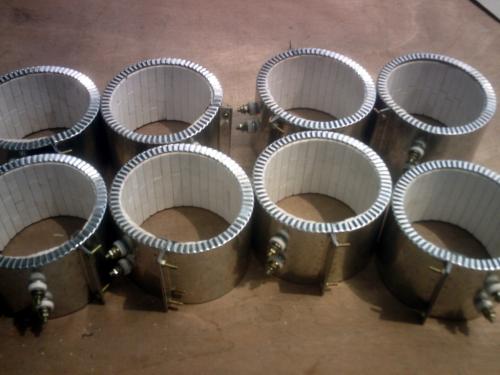
Electric heating coil (also known as electric heating ring or heating ring) is a ring-shaped electric heating element made of electric heating alloy wire as the heating material, mica soft board or ceramic core as the insulating material, and wrapped with thin metal plates (aluminum plate, stainless steel plate, etc.). It converts electrical energy into heat energy to heat objects, and is widely used for heating the barrels and containers of injection molding machines, extruders, film blowing machines, electric kettles, rice cookers, and other equipment.
Working principle
The heating principle of electric heating coils mainly includes three types:
Resistance heating: Based on the Joule effect (Q=I²Rt), when current passes through heating elements such as nickel-chromium alloy wire or iron-chromium-aluminum alloy wire, the resistance impedes the current, converting electrical energy into heat energy, which is then transferred to the heated object through heat conduction, radiation, or convection.
Electromagnetic induction heating: High-frequency alternating current passes through a coil to generate an alternating magnetic field. When a ferromagnetic metal is placed in the magnetic field, eddy currents are generated inside it. The eddy currents cause the metal atoms to collide and rub at high speed, generating heat energy, achieving self-heating of the metal, with a heat conversion rate of up to 95%.
Nano-infrared heating: Uses nano-scale composite conductive media to enhance the Joule effect, supplemented by 8μm~14μm far-infrared radiation directly acting on the barrel, achieving an electro-thermal conversion rate of up to 99.8%.
Main classifications
Classification by material
Table
Download as table
Export as image
Type Maximum temperature Surface load Features
Stainless steel mica heating coil Approximately 300°C 2.5~3W/cm² Simple structure, low cost, production not limited by specifications, suitable for conventional heating
Stainless steel ceramic heating coil 450°C~800°C 6.5W/cm² Ceramic strip wire-threading structure, fast heat transfer, long lifespan, energy saving of about 30%, resistant to high temperature without deformation
Cast aluminum heating coil 300~400°C 2.5~4.5W/cm² Die-cast or cast-formed, uniform heat conduction, high mechanical strength, can be equipped with air cooling/water cooling
Cast copper heating coil 500~650°C 3.5~5.0W/cm² Higher temperature resistance, better thermal conductivity than cast aluminum
Spring heating coil 650°C Up to 9W/cm² Spiral spring shape, uses elastic tension to closely fit the heated component, automatically compensates for thermal expansion and contraction
Electromagnetic induction heating coil Above 500°C — Induction heating principle, saves 50%~80% electricity, shell near room temperature
Nano-infrared heating coil 650°C — Electro-thermal conversion rate >99%, energy saving rate 30%~85%, low surface temperature, temperature control accuracy ±0.3°C
Classification by working mode
Resistance heating coil: Indirect resistance heating, heating element separated from the heated object, wide applicability, easy operation
Induction heating coil: Uses eddy current thermal effect in alternating electromagnetic field for heating, frequency covers power frequency (50~60Hz), intermediate frequency (60~10000Hz), and high frequency (>10000Hz)
Infrared heating coil: Uses far-infrared radiation as the main heat transfer method, high electro-thermal conversion efficiency
Typical applications
Table
Download as table
Export as image
Field Specific applications
Plastic machinery Barrel heating for injection molding machines, extruders, film blowing machines, pelletizers, wire drawing machines
Household appliances Electric kettles, rice cookers, electric irons, electric coffee pots
Heat treatment Local/overall quenching, annealing, tempering, through heating of metals
Hot forming Integral forging, local forging, hot upsetting, hot rolling
Welding Brazing, welding of cutting tools and blades, welding of steel and copper pipes
Metal melting Vacuum melting and casting of metals such as gold, silver, copper, iron, aluminum
Others Semiconductor single crystal growth, bottle mouth heat sealing, powder coating, metal embedding into plastics
Parameters to be provided for ordering/selection
Inner diameter and width (or height)
Rated voltage and power
Working temperature range
Lead wire form, length, and position
Whether thermocouple holes are needed (position and size)
Whether insulation layer is needed (adding insulation layer can save about 20%~35% electricity)
Special requirements: such as explosion-proof grade, air-cooled/water-cooled structure, special-shaped structure, etc.
Methods for detecting quality
Measure with multimeter resistance range: Touch the red and black probes to the two terminals, displaying a reasonable resistance value (can be calculated by formula R=U²/P, e.g., theoretical resistance for 230V/250W is about 211Ω) indicates normal; displaying infinity (OL) indicates internal open circuit; resistance close to 0 indicates internal short circuit
Measure insulation/grounding with multimeter: Measure the resistance between the terminal and the shell; normal should be infinity; if the resistance is only tens of kilo-ohms or buzzer conducts, it indicates insulation breakdown or leakage, and it cannot be used
Visual inspection: Check the surface for scratches, wear, deformation, damage, fractures, or burn marks
Temperature/heating effect test: After powering on, use an infrared thermometer to measure the surface temperature; overheating or too low temperature indicates abnormal operation
Test with voltage tester for continuity: Use a voltage tester with continuity buzzer to touch the terminal; buzzing indicates the internal resistance wire is conductive, silence indicates open circuit
Usage precautions
Working voltage must not exceed 110% of the rated value
The wiring part should be placed outside the heating layer and insulation layer, and the shell must be effectively grounded
The effective heating area must be in close contact with the heated body; empty burning is strictly prohibited
After long-term storage (more than three months), before use, it should be dried by intermittent power-on (heat for 10 minutes, stop for half an hour, repeat 3~4 times) to expel internal moisture
If the insulation resistance is below 1MΩ, it can be restored by baking in a 200°C oven for 5~6 hours
Avoid direct contact with corrosive media and moisture; store in a ventilated and dry place
Implementation/detection standards
JG/T 5052.2-1994 "Multi-nozzle ring tube heater"
KS C 2612-2013 "Electric heating coil for electrothermal resin sheets"