
Mineral Insulated MI Heating Cable Stainless Steel Sheathed Heating Cable High Temperature Metal Heating Wire Electric Heat Tracing Tape
The set of keywords you entered precisely points to the top-tier product in the industrial heat tracing field - MI (Mineral Insulated) heating cable. Compared with ordinary electric heat tracing tapes, MI heating cables have a qualitative leap in structure, temperature resistance, and safety.
Combined with your location in Yangzhou, Jiangsu (a domestic electric heat tracing industry cluster), I have sorted out the core structure, performance advantages, and selection key points of this series of products for you:
1. Core Structure and Heating Principle
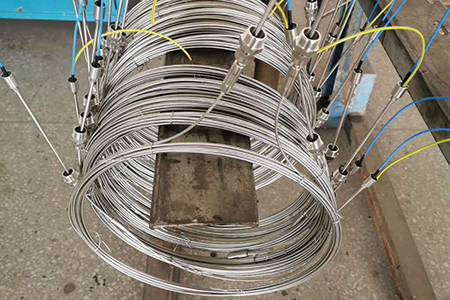
MI heating cable (armored heating cable) is a special cable with a "solid" structure, containing no organic materials inside:
Heating core wire: Uses single or multiple high-temperature metal heating wires (usually nickel-chromium alloy or iron-chromium-aluminum alloy) as the heat source.
Insulation layer: High-purity, high-temperature-resistant magnesium oxide (MgO) powder is tightly filled around the heating wire, serving for heat conduction and insulation.
Metal sheath: The outermost layer uses a seamless continuous metal tube (such as stainless steel, copper, or copper-nickel alloy) as the sheath, formed through multiple drawing and compaction processes.
2. Stainless Steel Armor vs. Other Sheath Materials
The "stainless steel armor" you specifically mentioned is a high-end series of MI cables. For different working conditions, the sheath material selection is as follows:
Stainless steel sheath: Extremely high temperature resistance, with a maximum withstand temperature of 600℃~650℃, extremely high mechanical strength, corrosion resistance, suitable for high heating power requirements.
Copper sheath: Maximum withstand temperature of about 250℃~300℃, suitable for heat tracing of long-distance pipelines, but with slightly weaker anti-corrosion capability; an outer sheath is needed for burial.
Copper-nickel alloy sheath: Maximum withstand temperature of 400℃~450℃, combining high-temperature resistance with excellent corrosion resistance.
3. Core Advantages (Why Choose MI Cable)
Extreme temperature resistance: Since all inorganic materials are used, there is no insulation aging problem, allowing long-term stable operation at temperatures above 600℃.
Explosion-proof, fire-proof, and waterproof: The seamless metal sheath and dense magnesium oxide insulation fundamentally prevent the intrusion of combustible gases, flames, and moisture, making it a truly explosion-proof cable.
High mechanical strength: The armored structure provides resistance to compression and vibration; even if the cable outer diameter is deformed by one-third, it can still work normally.
4. Key Installation and Usage Specifications
Constant power characteristics: MI cables are constant power heating, and crossing or overlapping installation is absolutely prohibited; otherwise, severe overheating at the overlap will cause burnout or even fire.
Must be equipped with temperature control: Due to its constant power, it must be equipped with temperature sensors and a temperature control box for precise temperature control to prevent medium overheating.
Bending radius limitation: Although softened, there are still certain bending radius requirements; do not kink or over-bend during installation.
Moisture-proof treatment: The exposed ends during construction easily absorb moisture from the air, so sealing and wiring must be completed in a very short time.
💡 Further Assistance
MI heating cables are highly customized industrial-grade products. May I ask what your specific needs are at present:
Working condition selection: Do you need me to help you choose the appropriate sheath material (stainless steel/copper/copper-nickel alloy) based on the maximum maintenance temperature on site, whether the environment is corrosive or explosion-proof?
Power and length calculation: Do you need me to help you calculate the required power per meter (W/m) and total length based on the size of the pipeline/container, insulation thickness, and target temperature?
Accessories and installation: Do you need to sort out the selection of explosion-proof junction boxes and terminal sealing kits specifically for MI cables, or understand the wiring specifications for on-site construction and temperature control systems?