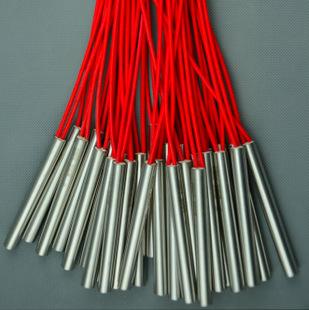

MI stainless steel mineral insulated heating cable armored heating tube 380V high temperature heating wire 220V
The keywords you entered cover two very core high-performance heating elements in the industrial heating field: MI stainless steel mineral insulated heating cables and armored heating tubes (including high-temperature heating wires). Combined with the voltage parameters "380V" and "220V" you mentioned, I have sorted out the core technical characteristics, voltage matching logic, and selection points of these two products for you:
1. MI Stainless Steel Mineral Insulated Heating Cable
This is a special heating cable whose core structure uses single or multiple nickel-chromium alloy heating wires as the heat source, filled with high-purity, high-temperature resistant magnesium oxide (MgO) powder as insulation and thermal conduction medium, and externally seamless extruded stainless steel tube as sheath.
Core advantages: Due to the use of all inorganic materials, it has extremely high mechanical strength, corrosion resistance, fire and explosion proof, anti-permeability, and can operate stably for a long time at high temperatures (maximum withstand temperature can reach 600°C or even above 800°C).
Application scenarios: Widely used in petrochemical pipeline insulation, large container heating, asphalt heating, nuclear industry, and various harsh industrial environments requiring high-temperature heat tracing.
2. Armored Heating Tube and High-Temperature Heating Wire
Armored heating tubes are usually made with alloy heating wires (such as nickel-chromium alloy Cr20Ni80 or iron-chromium-aluminum alloy) as the heating core, filled with magnesium oxide powder, and externally wrapped with stainless steel tube (such as 304 or 316L).
Material characteristics: Iron-chromium-aluminum alloy electric furnace wire has extremely high temperature resistance (up to 1400°C), good oxidation resistance, and low cost; nickel-chromium alloy electric furnace wire has higher high-temperature strength, is not easy to deform after cooling, and has better corrosion resistance (maximum operating temperature about 1200°C).
Application scenarios: Commonly used in industrial electric furnaces, ovens, mold heating, liquid (oil/water) heating, and laboratory equipment.
3. Wiring and Matching Logic for 220V and 380V
Whether it is heating cable or armored heating tube, when connecting to the industrial power grid, voltage matching is crucial. Wrong voltage connection will cause instant burnout or insufficient power of the equipment.
220V heating element: If the rated voltage of the equipment is 220V, when connecting to 380V three-phase power supply, star connection (Y connection) must be adopted. That is, connect one end of the three heating tubes together as the neutral point (connect to neutral wire), and the other ends respectively connect to the three phase wires. In this way, the actual voltage borne by each heating tube is exactly 220V.
380V heating element: If the rated voltage of the equipment is 380V, delta connection (△ connection) is required. That is, connect the three heating tubes end to end to form a closed triangle, and the three connection points respectively connect to the three phase wires, so that each heating tube directly bears 380V line voltage, running at full power.
💡 Further Assistance
Selection calculation: Do you need me to help you calculate the required power (W/m) and specifications based on pipeline length, container size, or medium temperature rise requirements?
Technical drawings/wiring guidance: Do you need me to provide you with specific star/delta wiring diagrams or installation precautions?
Finding suppliers: Do you need me to summarize the core qualifications and technical parameters that need to be confirmed when looking for such MI cable or armored tube manufacturers in industrial belts like Jiangsu?