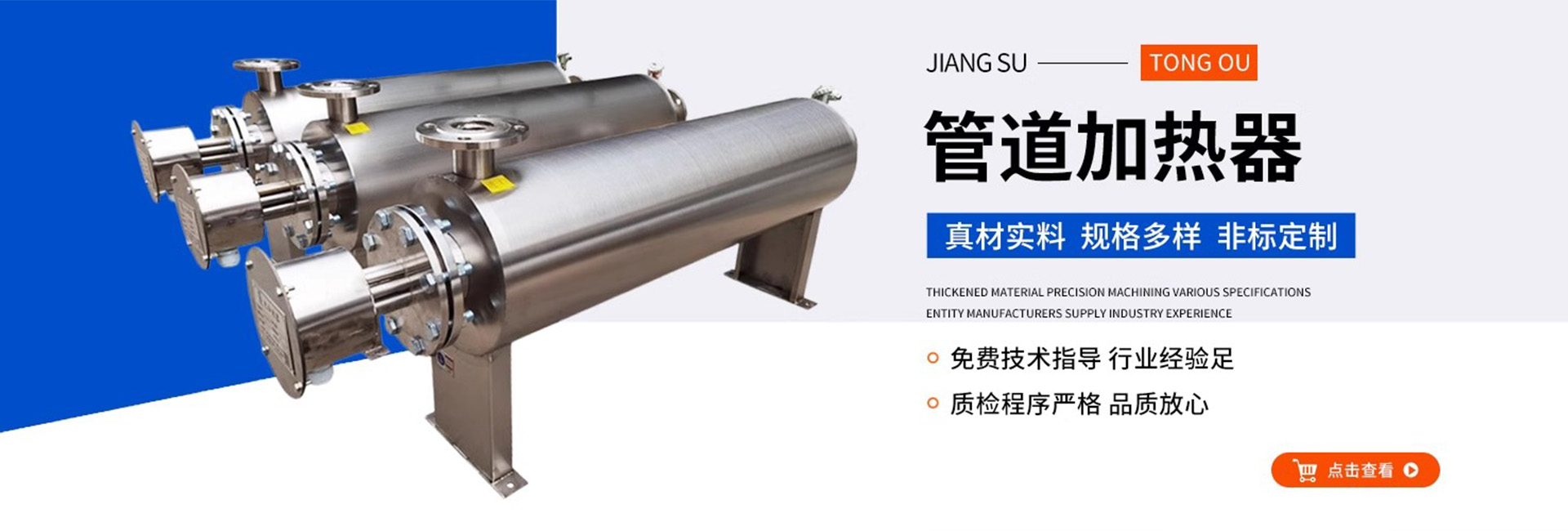

Pipeline Heater
A pipeline heater (also known as an "inline heater") is an electric heating device used to heat a pipeline or the fluid medium inside it. It is widely applied in petrochemical, electric power, aerospace, pharmaceutical, food processing, and other fields, and is an indispensable core device in industrial fluid heating systems.
Working Principle
The core principle of a pipeline heater is the Joule heating effect: low-temperature fluid medium enters the heater shell from the inlet under pressure, flows along the internal specific heat exchange flow channels, while the electric heating element converts electrical energy into thermal energy. The medium absorbs heat and rises in temperature during flow, ultimately exiting from the outlet to reach the temperature required by the process.
The entire working process includes three key stages:
Heating stage: Current passes through the high-resistance alloy resistance wire (nickel-chromium alloy or iron-chromium-aluminum alloy) inside the tubular electric heating element, generating Joule heat. The heat is conducted through the magnesium oxide insulating thermal conductive layer to the sheath wall, and then transferred to the flowing medium.
Flow guiding stage: Baffles are set inside the shell to guide the medium along a specific path, ensuring uniform heating and eliminating high and low temperature dead zones.
Temperature control stage: The outlet temperature sensor collects temperature signals in real time, feeds them back to the PLC or DCS control system, and automatically adjusts the heating power through PID calculation to achieve precise constant temperature control.
Structural Composition
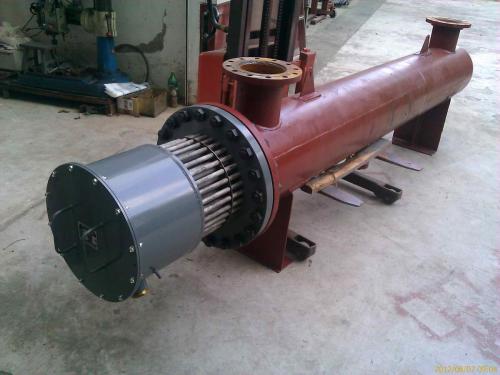
A pipeline heater mainly consists of the following parts:
Heating element: The core heating body, using a metal tube encapsulated with high-temperature resistance wire, with crystalline magnesium oxide powder filled in the gaps, providing both insulation and thermal conductivity.
Shell (housing): A pressure-bearing container, usually made of stainless steel, with heating elements and baffles installed inside.
Baffles: Optimize the flow path of the medium to ensure uniform heating.
Temperature control system: Composed of temperature sensors, PLC/DCS controllers, and silicon-controlled rectifier (SCR) power adjustment modules, enabling automatic temperature control.
Safety protection devices: Including overheat protectors, dry-heating protection, pressure interlocks, etc., forming a multi-level safety system.
Insulation layer: Reduces heat loss and improves thermal efficiency.
Main Classifications
By Heating Medium
Table
Download as Table
Export as Image
Type Features Typical Applications
Gas Pipeline Heater Fast heating speed, rapid temperature rise Heating of air, nitrogen, argon, ammonia, and other gases
Liquid Pipeline Heater Need to consider liquid specific heat capacity and fluidity Heating of water, thermal oil, heavy oil, lubricating oil, chemical media
By Heating Method
Table
Download as Table
Export as Image
Type Features Applicable Scenarios
Direct (Immersion) Type Heating element directly contacts the medium, high thermal efficiency Heating of non-hazardous media such as water and oil
Indirect (External) Type Indirect heating through a thermal conductive layer, high safety Scenarios sensitive to contamination such as food, pharmaceutical, and chemical industries
Electromagnetic Induction Type Uses eddy current effect to heat the pipe wall, non-contact Heating of crude oil long-distance pipelines
Hot Air Duct Type Specifically for gas heating, with air duct structure design Industrial hot air and drying systems
By Installation Method
Flange type: Connected to the pipeline via flanges, good sealing, suitable for high-pressure conditions
Plug type: Threaded connection, easy installation, suitable for small and medium diameter pipelines
External type (pipe wrapping type): Heating components are clamped on the outer wall of the pipe, not in contact with the medium, easy to disassemble and assemble
Main Features
High thermal efficiency: Almost all electrical energy is converted into thermal energy and transferred to the medium, with thermal efficiency reaching over 95%.
Fast heating speed: Can heat the medium from initial temperature to target temperature in a short time.
High temperature control accuracy: Uses PID intelligent temperature control, with accuracy up to ±1°C.
Good insulation performance: Thickened insulation layer effectively reduces heat loss, with significant energy-saving effects.
Comprehensive safety protection: Integrates mechanical protection, electrical protection, and system linkage protection, equipped with overheat protection, dry-heating protection, pressure interlocks, and other multi-level safety systems.
High medium heating temperature: Design working temperature up to 650°C, with special models higher.
Compact structure: Small size, small footprint, easy for on-site installation and movement.
Typical Technical Parameters
Table
Download as Table
Export as Image
Parameter Specification
Rated Voltage 110V / 220V / 380V / 440V / 660V
Nominal Power 1~6000kW (customizable)
Working Temperature 0~650°C (higher for special models)
Working Pressure 1.0~10.0MPa
Explosion-proof Class ExdⅡCT1~T6 (explosion-proof models)
Protection Class IP66
Temperature Control Accuracy ±1°C (PID control)
Heating Medium Air, nitrogen, water, thermal oil, heavy oil, chemical media, etc.
Shell Material Stainless steel (304/316L/310S)
Application Fields
Petrochemical: Heating of crude oil, heavy oil, lubricating oil, thermal oil, and other media, pipeline freeze protection and insulation
Electric power industry: Raw water heating in power plants, boiler feedwater preheating, desulfurization and denitrification system heating
Aerospace: Precise heating of various materials to meet scientific research and production needs
Pharmaceutical and food: Online heating of process water, cleaning solutions, and reaction materials
HVAC: Hot water heating in heating systems, auxiliary heating in air conditioning systems
Industrial manufacturing: Hot air heating in drying systems, mold temperature control, chemical media heating
Selection Key Points
Heating medium: Determine the type of medium to be heated (gas/liquid, corrosiveness, viscosity, etc.), and select corresponding materials and structural forms.
Power calculation: Calculate the required heating power based on medium flow rate, inlet and outlet temperature difference, and specific heat capacity (P = ρ·c·Q·ΔT / η).
Working pressure and temperature: Determine the shell pressure rating and temperature rating according to process conditions.
Explosion-proof requirements: For flammable and explosive places, select models with corresponding explosion-proof class.
Installation method: Choose flange type, plug type, or external type based on pipe diameter and on-site space.
Temperature control accuracy: For temperature-sensitive processes, select PID intelligent temperature control type.
Material selection: For corrosive media, select 316L or higher grade stainless steel.
Usage Precautions
Strictly prohibit power-on without medium: Ensure that the medium continuously flows through the heater before turning on the heating to prevent dry burning and damage to the elements.
Regular cleaning: When heating liquid media, scale may form on the tube wall, so regular cleaning is needed to maintain heat exchange efficiency.
Grounding protection: The equipment shell must be reliably grounded.
Moisture-proof storage: When out of service for a long time, drain the medium and keep the interior dry.
Interlock inspection: Regularly check whether safety devices such as overheat protection and pressure interlocks are working properly.