
Tubular Electric Heater
Tubular electric heater (also known as tubular heating element, electric heating tube, English Tubular Heater / Sheathed Heating Element) is the most common and widely used resistance-type electric heating device. It uses a metal tube as the outer shell, with a spiral resistance heating wire installed inside, and the gaps filled with crystalline magnesium oxide powder, formed through a tube reduction process. It is widely used for heating various media such as liquids, gases, and metal molds.
Working Principle
Based on the Joule heating effect: current passes through the spiral resistance wire inside the tube to generate heat. The heat is conducted through the filled magnesium oxide powder (which serves both insulation and thermal conduction functions) to the metal tube shell surface, and then heats the external medium through conduction, radiation, or convection.
Metal sheath tube In800, In840, 304, 316L, 310S stainless steel, aluminum, copper, low carbon steel, titanium tube, etc. Shell protection, corrosion resistance, heat transfer
Resistance heating wire Nickel-chromium alloy wire (Ni-Cr, temperature resistance 1400℃) / Iron-chromium-aluminum alloy wire (Fe-Cr-Al, temperature resistance 1200℃) Converts electrical energy into heat energy
Insulation filler Crystalline magnesium oxide powder (MgO), density ≥3.3g/cm³ Electrical insulation + thermal conduction medium
Lead rod/terminal Stainless steel or free-cutting iron, surface nickel-plated for oxidation resistance Connects to external power supply
Sealing material Epoxy, silicone, glass, etc. Prevents moisture intrusion
Insulator Ceramic, etc. Fixes and insulates the lead rod
Tube diameter is typically φ6~φ30mm. After tube reduction and compaction, the magnesium oxide powder ensures the heating wire stays centered without touching the wall.
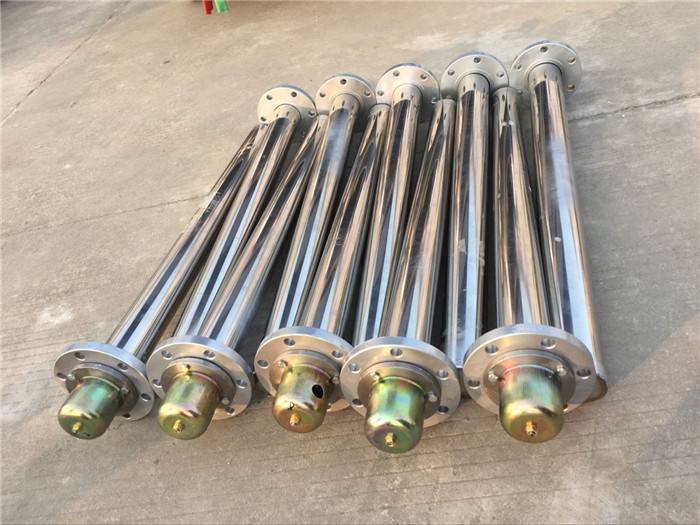
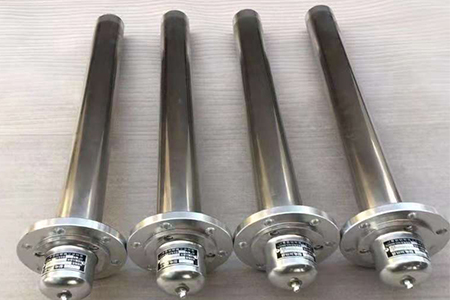
Straight single-end heating tube One-end outlet, immersible installation Oil tank heating, water tank heating
Straight double-end heating tube Two-end outlet, through installation Ovens, drying equipment
U-shaped heating tube Bent into U shape, increases heating area Water heaters, boiling water dispensers
W-shaped heating tube Multi-bend structure, suitable for large-area heating Industrial water tanks, cleaning tanks
Special-shaped heating tube Customized bending shape according to equipment Mold heating, special equipment
Spiral heating tube Spiral winding, compact and efficient Showers, water dispensers, dishwashers
In addition, there are variants such as finned type (expands heat dissipation area, suitable for air heating) and threaded type (enhances fluid turbulence).
Standard double-end lead type Type A Most conventional, one lead wire from each end
Single-end parallel lead Type C Two lead wires led out in parallel from the same end
Single-end coaxial lead Type D Two lead wires led out coaxially from the same end
Embedded element — Directly embedded into equipment shell
Rated voltage Single-phase 220V / Three-phase 380V (customizable for special cases)
Surface power density 0.7~15W/cm² (selected according to different media)
Maximum working temperature 850℃ (special design can reach 1050℃)
Tube diameter range φ6~φ30mm
Insulation resistance ≥1MΩ (at room temperature)
Dielectric strength 2KV/1min
Working pressure Standard ≤0.8MPa (high pressure custom up to 20MPa)
Explosion-proof grade Can reach dⅡB and dⅡC grades
Electro-thermal conversion efficiency ≥95%
Power density selection reference
Heating medium Recommended surface load
Water ≤3W/cm²
Mineral oil ≤0.7W/cm²
Air (forced convection) ≤2W/cm²
Air (natural convection) ≤1W/cm²
Acid-base-salt solution ≤1.5W/cm²
Low melting point metal melting ≤3W/cm²
Usage precautions
Strictly prohibited to dry burn: The effective heating area must be fully immersed in liquid or solid metal. Dry burning will cause the tube body to overheat and burn out
Working voltage shall not exceed 1.1 times the rated value, and the shell must be effectively grounded
When heating fusible metals or solid nitrate salts, alkalis, asphalt, paraffin, etc., the voltage should be reduced first, and then raised to the rated voltage after the medium melts
When heating air, the elements should be arranged crosswise and evenly to ensure good heat dissipation conditions
Scale or carbon deposits on the tube surface must be removed promptly, otherwise it will affect heat dissipation and shorten service life
The wiring part should be placed outside the insulation layer to avoid contact with corrosive, explosive media and moisture
Elements should be stored in a dry place; if long-term storage causes insulation resistance to drop below 1MΩ, it can be restored by drying in an oven at about 200℃ for several hours or energizing at low voltage for several hours
When the element surface temperature exceeds 450℃, brass lead rods are prohibited to prevent zinc volatilization
Household appliances Water heaters, ovens, coffee makers, water dispensers, dishwashers
Industrial heating Oil tank, water tank, acid-base tank heating
Plastic machinery Injection molding machine barrels, mold heating (200℃~300℃ and above)
Food processing Deep fryers (160~190℃), pasteurization, cooking equipment
Chemical equipment Reaction kettles, heat exchangers, chemical medium heating
Metal processing Aluminum profile mold heating, low melting point alloy melting
Energy and power Boiler feedwater preheating, desulfurization system pipeline heating
HVAC Air heating furnaces, duct heating, anti-freezing and de-icing
Laboratory equipment Constant temperature baths, drying ovens, molten salt furnaces
JB/T 2379-2016 Metal tubular heating elements Industrial tubular heating elements with working voltage ≤440V
GB/T 23150-2024 Tubular heaters for water heaters Tubular heaters for household water heaters (implemented on April 1, 2025)
NB/T 10309-2019 Anti-corrosion metal tubular heating elements Elements for household and similar purposes working in corrosive media
JB/T 7836.2-2026 Electric heaters for motors Part 2: Ordinary finned tube electric heaters Electric heaters inside motors or pits (implemented on September 1, 2026)
GB 1234 High resistance electric heating alloys Heating wire material standard
CB/T 3869-1999 Marine oil-water separation device - Technical conditions for tubular electric heaters Ship-specific
Energy-saving trend
According to industry research data, replacing traditional heating methods with high-efficiency tubular heating elements in boiler retrofits can achieve 15%~20% energy savings; in optimally designed process systems, the energy-saving rate can reach 18%~25%. Compared with gas heating, electric heating has advantages such as high temperature control accuracy, zero emissions, and fast response, and is increasingly favored in new projects.