
Tubular Heater
Tubular Heater (Sheathed Heating Element), also known as tubular heating element or electric heating tube, is the most common and widely used resistance-type electric heating device. It uses a metal tube as the outer shell, with a spiral resistance heating wire inside, and the gaps filled with crystalline magnesium oxide powder. It is manufactured through processes such as tube shrinking, and is widely used for heating various media such as liquids, air, and solid molds.
Based on the Joule heating effect: when current passes through the spiral resistance wire inside the tube, heat is generated. The heat is conducted through the magnesium oxide powder to the metal tube shell surface, and then heats the external medium through conduction, convection, or radiation.
The electric-to-heat conversion formula is:
Q = 0.2388 · I²Rt (unit: calorie)
Where I is current (A), R is resistance (Ω), and t is time (s).
Component Material/Specification Function
Metal sheath tube SUS304/316L/310S, In800/840, copper, aluminum, low carbon steel, titanium tube Mechanical support, corrosion resistance, heat transfer
Resistance heating wire Nickel-chromium alloy wire (Ni-Cr, temperature resistance 1400℃), iron-chromium-aluminum alloy wire (Fe-Cr-Al, temperature resistance 1200℃) Electrical energy→thermal energy conversion
Insulation filling layer Crystalline magnesium oxide powder (MgO), divided into low-temperature type (≤400℃), medium-temperature type (400~600℃), high-temperature type (600~850℃) Insulation + thermal conduction, compaction density ≥3.3g/cm³
Lead-out rod/terminal Stainless steel or free-cutting iron, surface nickel-plated for oxidation resistance Connect external power supply
Sealing material Epoxy, silicone, glass Moisture-proof sealing
Insulator Ceramic Fix and insulate the lead-out rod
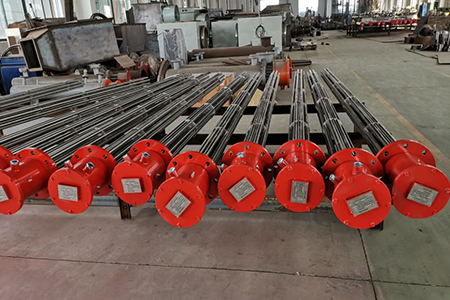
Straight single-end heating tube Single-end outlet, compact structure Mold heating, injection molding machine
Straight double-end heating tube Outlets at both ends, uniform power Water tank, oil tank
U-shaped heating tube Bent into U shape, increased heating area Water heater, boiler
W-shaped heating tube Multi-bend structure Large-capacity container heating
Spiral heating tube Coiled into spiral shape Shower, water dispenser, dishwasher
Special-shaped heating tube Customized bending shape according to installation space Special equipment
Tube diameter φ6mm~φ30mm
Voltage 12V~480V
Power Hundreds of watts to several kilowatts (single unit)
Surface power density 1.2~15W/cm² (lower for liquid heating, higher for air heating)
Maximum working temperature Conventional ≤850℃; high-temperature alloy type can reach 983℃
Insulation resistance At room temperature ≥50MΩ
Electric-to-heat conversion efficiency ≥98%
Explosion-proof grade Up to Ex db IIC T1-T6 Gb
Protection grade IP54~IP65
Surface power density matching: select 1.5~5W/cm² for liquid heating, 3~8W/cm² for air heating, 8~15W/cm² for dry-burning conditions; excessively high density easily causes tube wall overheating and oxidation
Sheath tube material: select 304 stainless steel for clean water; 316L for chlorine-containing/weakly corrosive media; Incoloy 800/840 for high-temperature dry burning; titanium tube for strong acids and alkalis
Lead-out rod temperature limit: when the element surface temperature exceeds 450℃, brass lead-out rods are prohibited (zinc will volatilize), and stainless steel lead-out rods should be used
Solid medium heating requires reduced-voltage startup: when heating solid oils such as asphalt and paraffin, use reduced voltage first, then increase to rated voltage after melting, to prevent heat concentration and shortened service life
Insulation resistance recovery: if the insulation resistance is lower than 1MΩ after long-term storage, it can be restored by drying in a 200℃ oven for several hours or energizing at low voltage for several hours
Household appliances
Water heaters, ovens, coffee makers, water dispensers, dishwashers, electric heaters
Industrial manufacturing
Injection mold heating, hot presses, laminating rollers/hot stamping rollers, chemical reactors, electroplating tanks
Fluid heating
Water tanks/oil baths, pipeline heat tracing and insulation, boiler startup heating, heavy oil/diesel preheating
Petroleum and chemical industry
Oilfield storage tank heating, refinery pipeline heat tracing, chemical plant polymerization reaction feed heating
Food processing
Continuous fryers (oil temperature 160~190℃), pasteurization (precise temperature control at 72℃), tunnel drying
Special scenarios
Vacuum electric furnaces, high-temperature drying rooms, low-melting-point metal melting furnaces, heating in explosion-proof occasions
JB/T 2379-2016 Metal tubular heating elements Core industry standard, replacing JB/T 2379-1993, applicable to industrial tubular heating elements with working voltage ≤440V
GB/T 23150-2024 Tubular heaters for water heaters Implemented from April 1, 2025, replacing GB/T 23150-2008, applicable to water heaters
NB/T 10309-2019 Anti-corrosion metal tubular heating elements Applicable to elements working in corrosive media, rated voltage ≤480V
GB/T 8623-1988 Metal tubular far-infrared radiation heaters Standard for far-infrared radiation type heaters
JB/T 4088 series Daily-use tubular heating elements Standard for daily use and similar purposes elements
Dry burning is strictly prohibited (unless explicitly marked as allowed): dry burning will cause local overheating of the tube wall, sintering failure of magnesium oxide powder, and in severe cases cause short circuits
Carbon deposits must be removed: if there is carbon deposit on the tube surface, it must be thoroughly removed before use, otherwise it will reduce thermal efficiency or even burn out the element
Store moisture-proof: should be stored in a dry place. After moisture absorption, insulation resistance decreases and drying treatment is required
Regularly test insulation: after a period of use, measure cold-state insulation resistance, and replace in time if lower than the standard value
Use with temperature controller: it is recommended to use a thermocouple + temperature controller for closed-loop temperature control to avoid temperature runaway