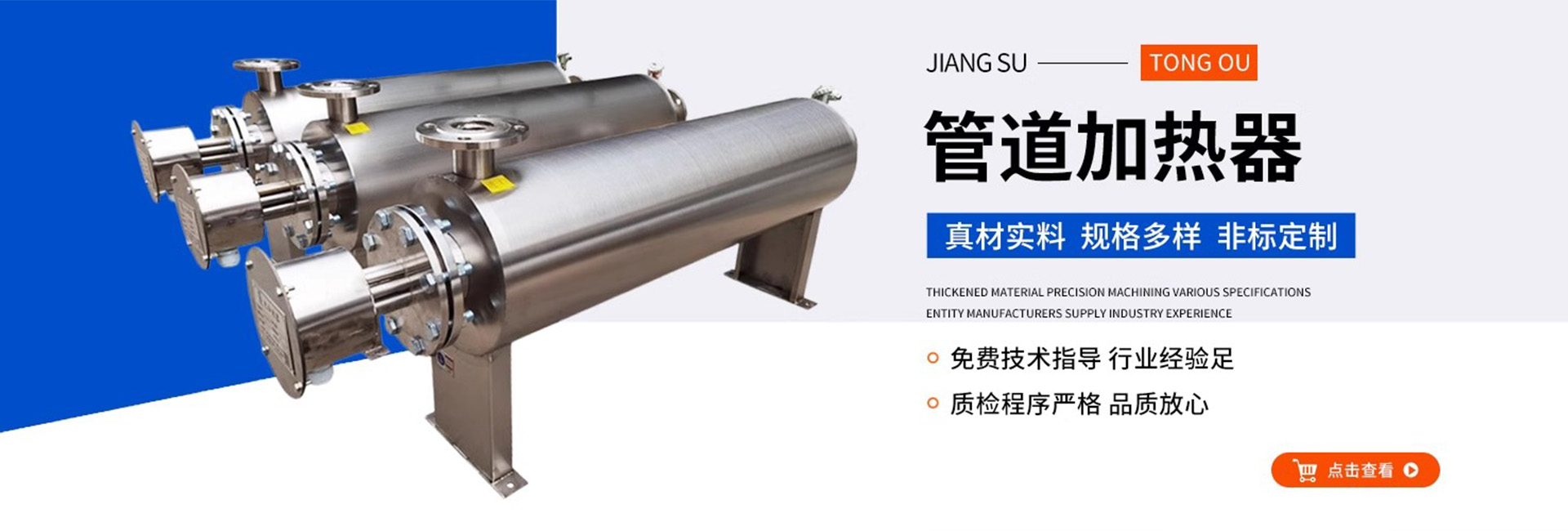

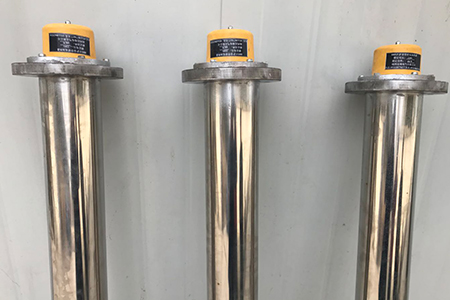
Sheathed Electric Heater
Sheathed electric heater (also known as sheathed type electric heater, armored electric heater, sheathed tubular electric heater) is a structured electric heating element that completely encloses the resistance heating core within a metal sheath. Through a three-layer coaxial structure of "core wire - insulation - sheath", it achieves safe and efficient heating, widely used for heating media such as hydraulic oil, lubricating oil, and heat transfer oil, as well as industrial scenarios like air heating, liquid heating, and mold heating.
Working Principle
The core principle of the sheathed electric heater is the Joule heating effect:
Electrical energy conversion: Current passes through the central high-temperature alloy resistance wire (such as nickel-chromium alloy wire, iron-chromium-aluminum alloy wire), generating Joule heat
Heat conduction: Heat is radially conducted to the inner wall of the metal sheath through the densely filled crystalline magnesium oxide powder (which serves both insulation and heat conduction functions) inside the tube
Heat release: The outer surface of the metal sheath transfers heat to the heated medium through convection, radiation, or contact conduction
Sheath protection: The metal sheath completely isolates the heating core from the heated medium, preventing corrosion, carbon deposition, and electrical leakage
Structural Composition
From the inside to the outside, it consists of a three-layer coaxial structure:
Table
Download as Table
Export as Image
Layer Material Function
Heating core wire Nickel-chromium alloy (NiCr), iron-chromium-aluminum alloy (FeCrAl), molybdenum disilicide (MoSi₂), etc. Core heat source
Insulation layer High-purity magnesium oxide powder (MgO), aluminum oxide (Al₂O₃), etc. Electrical insulation + thermal conduction
Metal sheath 304/316L stainless steel, Incoloy 800/840, titanium alloy, Hastelloy, etc. Mechanical protection + corrosion resistance + heat transfer
Main Classifications
Classified by model series (HRY/SRY series)
Table
Download as Table
Export as Image
Model Series Applicable Scenarios Features
HRY1/2/3 Oil heating for hydraulic and lubrication devices Flange connection, removable core for replacement, easy maintenance
HRY4/5 Dedicated for dilute oil stations Low surface power density, prevents oil carbonization
HRY6/7 High-power oil heating 380V power supply, 3~6kW
HRY8/9 Air heating Finned tube structure, increases heat dissipation area
SRY6 series Wind power gearbox heating Sheath tube diameter 108mm, wall thickness 4mm seamless steel pipe
BGY series Explosion-proof locations Explosion-proof rating dIICT4, protection rating IP65
Classified by structural form
Flange type: Connected to oil tank/container via flange, suitable for large storage tanks and reactors
Threaded type: Screwed into mounting hole, suitable for hydraulic oil tanks and lubrication systems
Finned type: Fins added to the sheath to increase heat dissipation area, suitable for air heating
U-type/W-type: Bent into complex shapes to adapt to different installation spaces
Key Technical Parameters
Table
Download as Table
Export as Image
Parameter Typical Range
Rated voltage Single-phase 220V / Three-phase 380V
Power range 1kW~8kW (single unit), complete equipment up to 6000kW
Surface heat density Oil heating ≤1~3W/cm²; Air heating ≤1~2W/cm²
Operating temperature ≤300℃ (standard type); high-temperature type can reach above 600℃
Working pressure ≤0.8MPa (standard type)
Working medium Mineral oil, heat transfer oil, lubricating oil, water, air, etc.
Insulation resistance ≥1MΩ
Dielectric strength 2kV/1min
Explosion-proof rating Exd IIC T4 (explosion-proof type)
Protection rating IP54 (standard type) / IP65 (explosion-proof and anti-corrosion type)
Service life 10,000~50,000 hours
Core Features
Core-sheath separable design: The heating core and sheath can be separated. When replacing the core, there is no need to drain the oil from the tank; simply extract the heating core, making maintenance extremely convenient
Low surface power density: The sheath has a large contact area with the heated oil and low surface heat density, so the oil will not carbonize or coke due to localized high temperatures
High mechanical strength: Uses cold-drawn seamless steel pipe or stainless steel pipe as the sheath, resistant to vibration and impact
Corrosion resistance: Different sheath materials such as 304, 316L, titanium alloy can be selected based on the medium
Safe and reliable: Fully enclosed structure, good insulation performance, explosion-proof type can meet requirements for hazardous locations
Typical Application Scenarios
Table
Download as Table
Export as Image
Industry Application Scenarios
Hydraulic/Lubrication Oil temperature heating for hydraulic oil tanks and lubrication systems, preventing difficulty in starting at low temperatures
Wind power Gearbox lubricating oil heating for anti-freezing
Chemical/Petrochemical Reactor jacket heating, preheating high-viscosity fluids to reduce viscosity
Electric power Transformer oil heating, switchgear moisture-proof heating
Food/Pharmaceutical High-pressure steam sterilizers, tunnel-type food drying
Semiconductor Vacuum CVD/PVD reaction chamber heating, lithography machine heating plate
New energy Lithium battery cathode material sintering furnace, hydrogen energy electrolyzer preheating
Selection Key Points
Clarify the heating medium: For water/soft water, choose 304 stainless steel sheath with surface power density of 5~10W/cm²; for oil, choose 304/316L with surface power density strictly controlled at 1~3W/cm²; for corrosive media, choose 316L or titanium tube
Air heating must be equipped with fin structure, power density maintained at 1~2W/cm², and dry burning without fins is strictly prohibited
Explosion-proof locations must use explosion-proof type (BGY series) with matching explosion-proof junction box
Power calculation follows the principle of "sufficient but not redundant", comprehensively calculated based on medium mass, specific heat capacity, target temperature rise, and heating time
Installation method: Choose straight tube, U-type, W-type, flange type, etc., according to equipment space
Usage Precautions
The effective heating zone must be fully immersed in liquid or solid metal; dry burning is strictly prohibited
Working voltage must not exceed 1.1 times the rated value, and the shell must be effectively grounded
If scale or carbon deposits are found on the tube surface, remove them promptly to avoid affecting heat dissipation and shortening service life
When heating fusible metals or solid nitrates, asphalt, paraffin, etc., first reduce the operating voltage, and after the medium melts, raise it to the rated voltage
If insulation resistance is below 1MΩ after long-term storage, it can be restored by drying in an oven at 200℃ or by heating with reduced voltage
The wiring part should be placed outside the insulation layer to avoid contact with corrosive, explosive media and moisture