
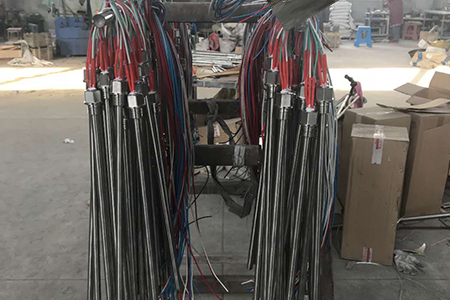
Bolt Electric Heating Rods
Bolt electric heating rods are indispensable core specialized tools for the maintenance of steam turbines in thermal power plants, nuclear power plants, and large petrochemical enterprises. They are specifically used for the hot tightening and disassembly of large-diameter flange stud bolts in high and intermediate pressure cylinders, main stop valves, governor valves, etc. The core logic is to heat the bolt so that it expands thermally, thereby applying precise initial stress during tightening, or utilizing thermal expansion to overcome corrosion and seizure resistance during disassembly.
Based on your daily attention to the selection and procurement of industrial electric heating equipment, the following summarizes their core classifications, selection pitfall avoidance guide, and procurement suggestions for surrounding manufacturers.
⚙️ Core Classifications and Working Principles
Bolt electric heating rods are mainly divided into two major categories: resistance type and induction type. The two have significant differences in operational efficiency and applicable scenarios:
Resistance heating rods (traditional mainstream): Adopt the classic structure of "resistance wire—magnesium oxide powder—metal sleeve." When in use, they are directly inserted into the center hole of the bolt. After energization, the resistance wire generates heat, which is conducted to the bolt body through the magnesium oxide powder and metal sleeve. Their structure is simple and cost is low, but the heating speed is relatively slow (usually requiring about 1.5 hours to reach the target temperature).
Induction heating rods (efficient advanced): Based on the principle of electromagnetic induction, eddy currents are directly generated inside the bolt metal through an alternating magnetic field to generate heat. This is non-contact heating, with extremely fast temperature rise (for example, a stud with a diameter of 100mm and a length of 1000mm only needs 8 minutes to be heated to 300°C), and the thermal energy conversion rate can reach over 95%. It is suitable for large-batch rapid operations or scenarios where the maintenance schedule is extremely tight.
Key Parameter Guide for Selection
During industrial procurement and selection, it is recommended to focus on confirming the following four dimensions of parameters to match actual working conditions:
Dimensional matching (determines whether it can be inserted and heating uniformity)
Center hole diameter and rod body diameter: This is the most core parameter. Bolt heating rods need to be customized according to the specific geometric dimensions of the bolt. Among standard parameters, the bolt center hole diameter is usually between 10mm-36mm, and the outer diameter of the heating rod needs to maintain a reasonable clearance of 0.8mm-1.3mm with the center hole. If the clearance is too small, it cannot be inserted; if the clearance is too large, the heat transfer efficiency is greatly reduced.
Length specifications: It is necessary to clarify the total length of the bolt, flange thickness (i.e., heating length), and nut length. The heating section of the heating rod must accurately correspond to the stressed section of the bolt. The cold end length at the bottom is usually required to be 25mm-30mm to prevent heat from being conducted to the threaded part and causing damage.
Electrical parameters and power density (determines heating speed)
Rated voltage: Industrial sites commonly use AC 220V (±20V). Some power plant maintenance control cabinets use DC 100V or low voltage 50V. Before procurement, the voltage system of the supporting control cabinet must be verified.
Surface power density: The surface power density of bolt heating rods is usually selected as 8-11W/cm². If the power density is too high, it is easy to cause local overheating and burnout; if too low, the temperature rise is slow, delaying maintenance progress.
Structural form: Divided into hard tube type (straight rod) and flexible tube type. For ultra-long bolts or concealed positions with limited space, flexible tube heating rods can bend to adapt, making installation more convenient.
Material and temperature resistance grade (determines service life)
Sleeve material: For conventional working conditions, 1Cr18Ni9Ti heat-resistant stainless steel tubes are selected; if special corrosive environments or higher temperatures are involved, it is necessary to negotiate with the manufacturer to switch to seamless steel tubes or other alloy materials.
Insulation and heating materials: High-purity dried magnesium oxide powder meeting standards must be selected as the insulation medium, and the heating wire adopts 0Cr27A17Mo2 high-resistance electric heating alloy wire, whose long-term working temperature must reach above 400°C.
Safety performance and life indicators (determines on-site safety)
Insulation resistance: Measured with a 500V megohmmeter in cold state (room temperature), the insulation resistance must not be less than 50MΩ; in hot state, the insulation resistance must not be less than 0.5MΩ, and the leakage current must not exceed 0.5mA per kilowatt.
Withstand voltage test: It must be able to withstand an AC 1500V-2000V withstand voltage test for 1 minute without breakdown or flashover.
Cumulative life: Under intermittent heating conditions (10-20 minutes each time), the cumulative service life should be no less than 50 hours.
Common Models and Surrounding Manufacturer Reference
Common bolt heating rod models on the market are mostly named according to applicable bolt specifications, such as the DJ22 series (applicable to M56-M76 bolts), ZDX series, ZJ-20 series, etc.
In terms of procurement channels, Jiangsu and surrounding areas have concentrated a large number of electric heating equipment manufacturers. In addition to relevant electrical enterprises in Yangzhou (such as Baoying County Hengtai Electrical Equipment Factory, etc.), surrounding Zhenjiang (such as Zhenjiang Yunlong Electric, Zhenjiang Dongxin Electric, etc.), Yancheng, and other places also have many source manufacturers with non-standard customization capabilities. It is recommended that during actual procurement, directly provide the manufacturer with specific bolt drawings (including center hole diameter, total length, heating section length, nut dimensions) and the voltage parameters of the supporting control cabinet, and require the other party to issue detailed selection drawings and factory test reports (including insulation resistance and withstand voltage test data) to ensure that the equipment is put into use safely and efficiently during steam turbine overhauls.